 As pure entertainment goes, V is a good movie. My problem with it is that I'm too familiar with the source material and therefore I'm under the impression that some other team of writer/director could have done much better. And I'm not playing the purist ("that's not what happens in the graphic novel"), cause that's an attitude that has always bothered me. Literature, movies, and comics are different media, each with its own set of rules and objectives. Elements that work fine in one not necessarily will do so in another, so one should not be looking out for literal translations of any work from one media to another -where would be the fun in that?-.
And in some cases, such as this, you have to take into account the time when the original work was created and compensate for it so than your adaptation doesn't end up being an anachronism.
V for Vendetta was written in the early 80s, and it is permeated with the feel of opression in the UK during Margaret Thatcher rule. Alan Moore's work, specially in those years, has always being heavily influenced by the world around him at the time of writing, and his ability to include social commentary on his work without interfering with his storytelling has always been one of his most celebrated skills, as works like Watchmen, D.R. and Quinch y The Ballad of Halo Jones can atest to.
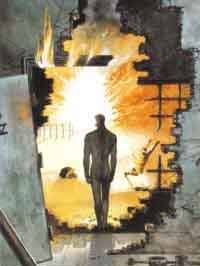 The Wachowski Bros. tried to imbebe their own social-political stance in their adaptation, making their British totalitarian regime a mirror of the Bush administration. But it soon becomes evident than the Wachowskis are not Alan Moore. As in the religious part of the tale. Guy Fawkes was a catholic English soldier who tried to blow up the Parliament with most of the ruling -protestant- class in there. V using a Fawkes mask made sense in the Graphic Novel (GN) as a symbol of discontent and rebellion to the powers that be. Doing so to stand against a government of fanatic -catholic- leaders does not. And if Budhism is to be mixed in -Evey proclaiming that "God is in the rain" after having her head shaved-, the story starts to lose in terms of ideas.
And I insist, I'm not being a purist. I applaud getting rid of the supercomputer in charge of the government, and I think than having Prothero becoming a TV show to be an opinion leader was a brilliant twist. Changing Susan's name to Suttler I can understand, but making him a second-rate Hitler don't. The homage to Orwell's 1984, using John Hurt, who starred in the film version, was nice, but it also gave a face to the powers that be, limiting the idea behind it. The experiments at Larkhill have much more sense as biological weapons research than those showed in the GN. But having V become a victim of the fire instead of the mastermind behind it is wrong. It gives a different reason as to why embark in a crusade to kill his wrong-doers, and, oh, why not, let's fix the world while we're at it.
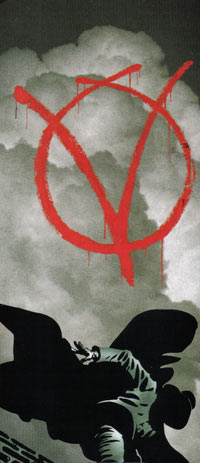 V says buildings are symbols. The movie reaches its climax with the blowing up of the Parliament. Shouldn't that particular building be the symbol for democracy? Why not blow out Dowling St. government headquarters, or Scotland Yard, both seen as symbols of authorities corrupted by power. And this contradictory ideas are all over the movie. At no point it gets clear wether V is a revolutionary as opposed to a terrorist. Leaving that to according to who is one thing, but the problem is that V is conceived as a hero. The Wachoskis have declared at any chance possible that V should not be perceived as a hero. Yet they give him a moral superiority from the very first moment. And being he the victim of the Power Players' games, he's not a mere hero, but a tragic one. A martyr.
The totalitarian regime they are supposed to show us it's not there. Sure, there are censorship, what's new? Media controlled by the government? So? They tell us the government watches and listens to every single conversation, yet people swears and mocks everytime they hear a lie on TV. They don't seem very afraid to me. Family homes and even bars are clean and the life quality seems more than OK. People are well dressed and apparently well fed. They say there are shortage of some food and products, yet a girl can easily get a can of spray paint to deface government's propaganda. Also, if things are that bad, how come her parents let her out on her own? Winston Smith -John Hurt's character in 1984- would have thought he died and gone to heaven after waking up in this world.
I could go on listing some other incongruencies, but I see no point in it. In the end, this Wachowski/McTeigue's reinterpretation of V for Vendetta has much more in common with The Matrix than it does with Alan Moore's work. Also, if they wanted to borrow things from other movies, there were far better options than their own work -whose originality is also quite questionable-. If only somebody would have lended'em a copy of Fight Club...
Originally published in Spanish on April 5th, 2006.


No comments:
Post a Comment